spacer
Penn Home


spacer spacer
arrow Penn Advantage
  Curriculum Versatility
On-Campus Resources
Location
Scheduling Adaptability
spacer spacer
arrow What is Biotechnology?
  Recombinant DNA
Producing New Crop Species
Clinical Diagnostics
Medical Therapy
Bioinformatics and Processing
Producing Biomaterials
spacer spacer
arrow Master's Program Overview
  Curriculum
Admissions
Forms
FAQs
spacer spacer
arrow MBA/MB Dual Degree Program
  Curriculum
Advising
Admissions
FAQs
spacer spacer
arrow Faculty
spacer spacer
arrow Seminars & Events
spacer spacer
arrow News
spacer spacer
arrow Links
spacer spacer
arrow Calendar
spacer spacer


spacer


spacer Penn Homepage http://www.seas.upenn.edu School of Arts & Sciences

Master's Program Curriculum

Students are required to complete 11 credit units* (cu's) for this degree. Those 11 credit units are comprised of 6 core areas and 5 track electives.

Core Curriculum
Molecular Biology Track
Biopharmaceutical/Engineering Biotechnology Track
Biomedical Technologies Track


CORE CURRICULUM
Each student must take one course from each of the following 6 core areas.

  1. Biochemistry
  2. Biotechnology I: Cellular/Molecular Biology
  3. Biotechnology II: Engineering Biotechnology
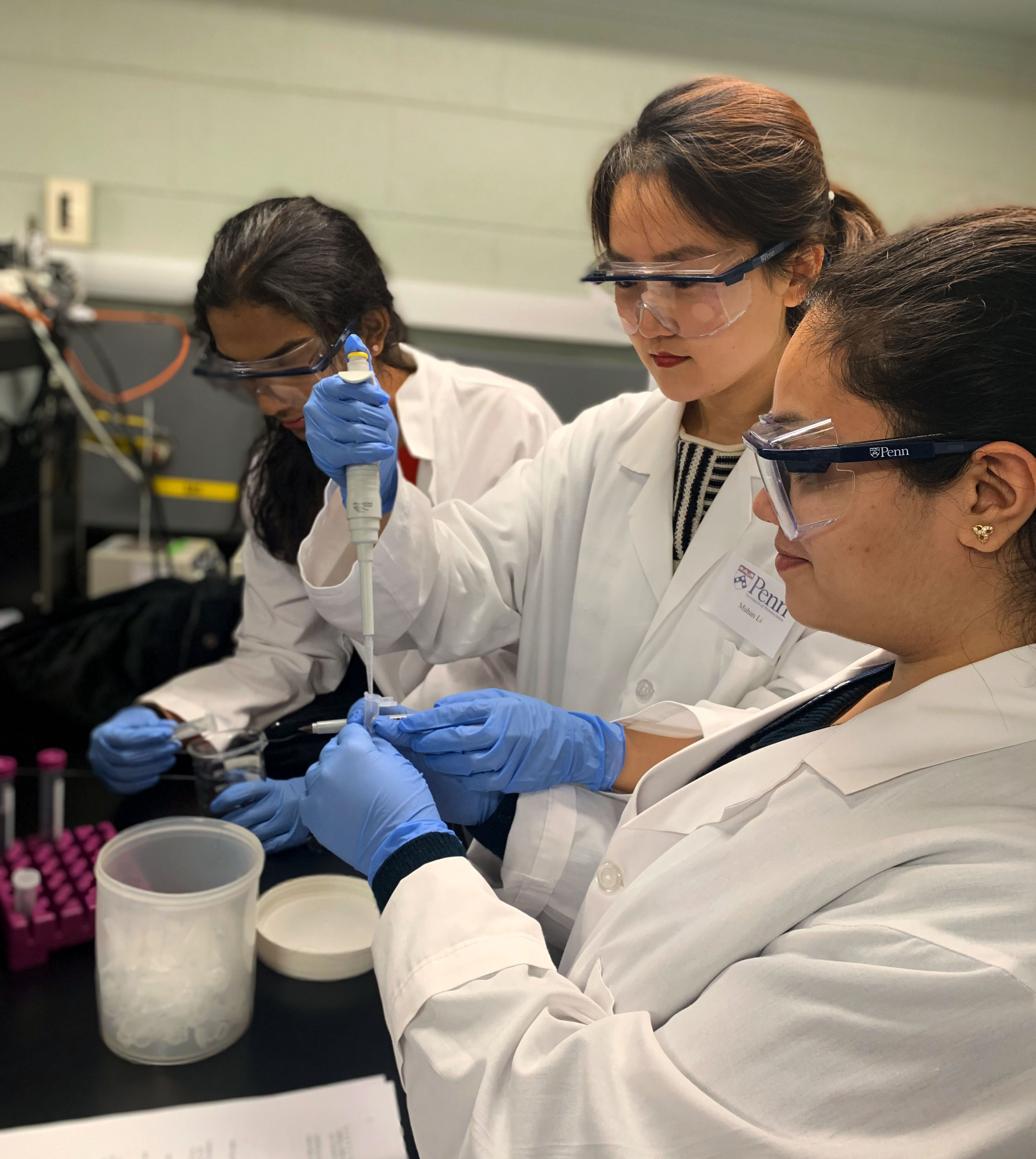
  4. Laboratory in Biotechnology and Genetic Engineering
  5. Statistics
  6. Seminar/Free Elective


TRACK CURRICULA

Each student is required to select one of the following tracks and select their 5 electives according to the respective requirements.

Molecular Biology Track
Advanced Biology Electives.
Each student must take three advanced biology electives, including at least two from the following list.

  • Molecular Genetics (Biol 421)
  • Experimental Principles in Cell and Molecular Biology (Biol 526)
  • Advanced Cell Biology (Biol 480)
  • Genetic Analysis (Biol 540)
  • Immunobiology (Biol 404)
  • Communication at the Cellular Level (Biol 482)
Research.
Students in the Molecular Biotechnology Track are REQUIRED to complete two credit units of independent study. This may be done during one semester, or two semesters (consecutive or non-consecutive).


Biopharmaceutical/Engineering Biotechnology Track
Quantitative Electives
Each student must choose at least two of the following quantitative electives.
  • Quantitative Human Physiology (BE 505)
  • Biomechanics and Transport (BE 510)
  • Cell Biology and Molecular Structure (BE 513)
  • Foundations of Engineering Mathematics I (ENM 510)
  • Foundations of Engineering Mathematics II (ENM 511)
  • Nanoscale Systems Biology (CBE/BE 555)
  • Transport Processes I (CBE 640)
  • Transport Processes II (CBE 641)
  • An advanced course in Mathematics or Transport Phenomena.
Advanced Electives
Each student must choose two advanced electives in one of the relevant disciplines.
  • Biomaterials (BE 512)
  • Tissue Engineering (BE 553)
  • Molecular Biophysics (BMB 508)
  • Molecular Genetics (BIOL 421)
  • Microbiol. & Biotechnol. and Lab (BIOL 475,476)
  • Advanced Cell Biology (BIOL 480)
  • Computational Biology (BIOL 536, 537)
  • Cellular Bioengineering (CBE 552)
  • Fundamentals of Pharmacology (PHRM 623)
  • An Advanced Elective (at the 500 level or higher) in one of the relevant disciplines.
  • Independent Study (BIOT 599)


Biomedical Technologies Track
Quantitative Electives
Each student must choose at least two of the following quantitative electives.

  • Quantitative Human Physiology (BE 505)
  • Cellular Engineering (BE 552)
  • Nanoscale Systems Biology (BE 555)
  • Drug Discovery & Development (BE 562)
  • Mathematical Computation Methods for Modeling Biological Systems (BE 567)
Advanced Electives
Each student must choose at least two advanced electives from the Bioengineering department
  • Molecular and Cell Biology (BE 513)
  • Courses listed above fulfill this requirement as well
  • An Advanced Elective (at the 500 level or higher) in one of the relevant disciplines.
  • Independent Study (BIOT 599)


Course Descriptions
Course Schedules (Timetables)


*In most cases 1 course is equivalent to 1 credit unit. However, there are some .5cu courses available that fufill requirments of the degree. Students in the program are responsible for making sure they not only meet the course requirements but the 11cu requirement as well - in some cases that may mean taking additional classes.

spacer Penn Homepage http://www.seas.upenn.edu School of Arts & Sciences


   Master of Biotechnology Program Office
   220 S. 33rd Street, Rm. 109
   University of Pennsylvania
   Philadelphia, PA 19104-6391
   Phone: 215.898.0221/Fax: 215.573.5577


Back to MEAM Home