Penn Computing

Penn Computing

Computing Menu Computing A-Z
Computing Home Information Systems & Computing Penn


Saturday, July 19, 2008

 
  Security Checklists & Policies
Secure desktop computing
Secure servers
Secure web applications
Tips for safe computing
Computing policies
 
  Email
Harassment & Forgery
Hoaxes, frauds & scams
Spam & Email relays
Encryption & digital signatures
 
  More in-depth information for
Local support providers
System administrators
Application developers
 
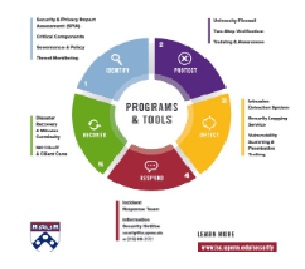
  Security initiatives
Critical host compliance
Authentication & authorization
Penn Security & Privacy Assessment (SPIA)
 
  Related links
Electronic privacy
PennKey
Viruses
Worms, trojans, backdoors

Reporting Problems to Penn Information Security

Penn's Office of Information Security is available to respond to computing security incidents on a 24-hour a day, 365-day a year basis. You can reach us in either of the following ways:

  • Telephone: (215) 898-2172 - if there is no answer (such as during non-business hours or on weekends and holidays) you will hear a voice mail message that will provide a number at which the on-duty Information Security technician can be paged.
  • E-mail: security@isc.upenn.edu - this address is read regularly around the clock by Information Security personnel, but response will not be as rapid as with phone messages/pages.

If your problem is critical or a genuine emergency, contacting us by telephone is the recommended option.

IMPORTANT! If you believe that the computer security issue you wish to report involves a possible threat to the personal safety of yourself or any other person, or if you believe that it involves criminal activity (including identity theft), we strongly urge you to report it directly to Penn Public Safety by calling them at 511 (on-campus) or 215-573-3333 (off-campus). Although Penn Information Security is not a law enforcement agency, we will consult with Public Safety on criminal investigations involving computing security.

If you're unsure about what you should report, or how you should report it, here are a few suggestions:

  • If you are reporting an attack against a computer belonging to you, and the attack appears to be coming from or involve a computer that is part of Penn's network, it is very helpful if you can forward any logs you have that detail the attack to us at security@isc.upenn.edu to assist in the investigation.
  • If you are a Penn computer user, and you have reason to believe that one or more of your computers has been compromised (especially if the computer is covered by the Critical Host Policy ), then report it to us along with any logs or other evidence you have detailing the compromise. It's also a good idea to unplug the affected machine(s) from the network until the matter is resolved.
  • If you are reporting what you believe is a violation of copyright law involving a computer that is part of Penn's network, please read this page before making your report.
  • If you are contacting us about a forgotten PennKey password, lost or expired Setup Codes, or anything related to your PennKey, please note: University policy and security guidelines do not permit Setup Codess to be issued by telephone or email, nor can anyone in Information Security set or reset your PennKey password. You will need to visit one of the PennKey Administration Offices to be issued a PIN, or request one be (postal) mailed to you using the automated PIN Request Line. For more general information on PennKey, please visit http://www.upenn.edu/computing/pennkey or write to pennkey@isc.upenn.edu
  • If you have received an email (usually from Nigeria or other African country) that seems to involve a scheme offering you millions of dollars to help launder "trapped" funds, please don't report it to us. Read this instead: http://www.upenn.edu/computing/security/advisories/419scam.html

The above does not cover all situations, of course, so if you think there's any possibility that your problem concerns computing security, it's better to ask us and find out that everything's OK than to let it ride and risk it becoming a much more serious problem.

Last updated: Thursday, May 24, 2007

top

Information Systems and Computing
University of Pennsylvania
Comments & Questions


Penn Computing University of Pennsylvania
Information Systems and Computing, University of Pennsylvania