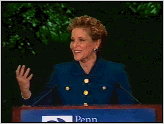
JUDITH RODIN: (Joined in progress) ...culture and public behavior,
leadership in a democratic society and the 21st-century community.
Each group is focused on one of these fundamental social problems.
Each group is charged with analyzing it and offering for consideration
by the whole commission ideas that may help us all to think and act
differently about the important issues and important choices that we
face every day.
Today and tomorrow we will continue with this essential task. With
the help of our keynote speakers, we will focus on ways in which some
institutions in our society--professional sports, colleges and
universities, government, military service--can exert a more positive
influence on public behavior, and on the tenor of public discourse and
culture. With the framework of our two previous meetings in place and
the recommendations of this week's keynote presenters before us, we
will be able to turn tomorrow afternoon to the task of deliberating
together as an entire commission. We will for the first time take up
the specific recommendations made by our presenters and those who
preceded them in the first two sets of meetings, and try to come to
some consensus regarding them and their broader applicability to
society.
With the results of these deliberations in hand, we can look forward
to our work over the next year. This winter and spring, for the first
time, we will begin the important task that we defined for ourselves of
reaching out to a wider group of present and emerging leaders, as well
as to many of the institutions and professions that they represent,
and indeed, reaching more broadly to the general public. Not only
do we want to share with them the preliminary ideas and
conclusions coming out of our deliberations, but we must engage them
in the dialogue to create a network of activities surrounding the
commission's activities.
In Chicago next June, we hope to engage some of these leaders and
their professional communities directly, to engage them about the
tasks and possibilities of leadership in a democratic society. Then
in Los Angeles a year from now, our focus will be on ways to
reinterpret and reconceive the concept of community for a 21st-century
America, an America that will certainly be, as Richard Rodriguez told
us last June, vastly different from the one in which most of us were
raised.
Running through our discussions of public behavior, leadership and
community will be of central concern for the character of the
public conversation that binds us together. Many institutions in our
society play a powerful role in shaping that conversation, and today's
session and tomorrow's will allow us to examine several of them. One
of them, of course, although sometimes overlooked, is the modern
business corporation, and as many of you know, one of our originally
scheduled speakers for this meeting was the late CEO of Coca-Cola,
Roberto Goizueta.
Roberto was one of those rare corporate leaders who truly understood
the capacity of leaders to change institutional cultures. His
personal characteristics--warmth, openness and unfailing civility; his
willingness to accept responsibility for monumental blunders as well
as for enviable successes--these deeply influenced the corporate
culture at Coca-Cola, an international network of 69,000 employees and
2.2 billion customers.
In a commencement address last spring at Loyola University in Chicago,
Roberto spoke of the erosion of our society's civic
infrastructure, something that concerned him deeply. More important,
he recognized that businesses, like other institutions, have a real
stake in the issues that we've convened to consider. To those with
doubts, he pointed out that it was a reputation for poor customer
relations and terrible service that spawned the competition that
toppled the telephone industry; certainly, the telephone monopoly.
The same thing is now happening in the cable television industry.
Roberto saw clearly, and I quote, "Managing a business requires
maximizing the value of the company's assets, and a corporate culture
of incivility and intolerance thwarts the development of a company's
most important asset: its people." He saw, too, that, much as in
academe, where our international disciplinary communities may be our
most important sources of self-definition and companionship and
communication, so too was it in the business world.
He wrote, "Today, for many of us, our company is the institution that
most defines our sense of community. We may know the colleague we
work with side by side or one we e-mail in Europe better than we know
the neighbor down the street. The internal civility and robust
discourse of the modern multinational corporation can contribute as
much to the formation of a tolerant and vibrant community for its
employees and for our society as the freewheeling exchanges on our
campuses and our disciplinary communities," end quote.
And creating such robust conversation is in no way incompatible with the
success in the competitive world of business. Certainly, under
Roberto Goizueta's leadership, Coca-Cola was transformed -- transformed
from a slow-footed, bureaucratic, quite conservative company into one
of the greatest generators of shareholder wealth in international
corporate history.
Corporations are but one of the major institutions that have this kind
of power, the power to shape public culture and public behavior.
Certainly no one can doubt that professional sports, with its amalgam
of mass-market appeal and profit motives and the competitive ethos of
athletes and the spectators alike is another. From the poor role
modeling of Roberto Alomar and Dennis Rodman, to the long fights for
integration on the playing field and in the front offices, to the
cradle-robbing parents of the child tennis pro, professional sports
certainly does present powerful models of behavior, often of negative
behavior, for all aspects of our society.
And yet we should not forget that for every Dennis Rodman, there's
also an Arthur Ashe. For every Roberto Alomar there's also a Tiger
Woods. And for every Marge Schott there's also a baseball
commissioner like Bart Giamatti.
Professional sports offers us a difficult and demanding focus for our
first discussion of the responsibilities of institutions for
influencing the patterns of public behavior and the tenor of public
discourse. To lead us in this consideration, we are truly fortunate
to have with us today a member of the commission who is widely
recognized as the nation's leading authority on sports and society.
Richard Lapchick has spent much of the past three decades working to
understand and enhance the social role of professional sports. As a
graduate student he was the first recipient of the Ford Foundation's
Martin Luther King Fellowship for research on international race
relations; wrote his dissertation on the politics of race and
international sport in South Africa. In the years since, he has been
repeatedly recognized for his leadership on the issue of apartheid-era
South Africa's participation in international sports competitions.
Recipient of the Ralph Bunche International Peace Award, the
Anti-Defamation League's World of Difference Award, the Aetna
Foundation's Arthur Ashe Voice of Conscience Award, Richard is the
founder and director of the Center for the Study of Sport and Society
at Northeastern University and president of the National Consortium of
Academics and Sports. Author of eight books and more than 250
articles, he brings to us his wide experience in innumerable projects
aimed at ending racism in sports, in understanding the relationships
between athletics and violence, and grappling with the complex
interactions of business, athletic competition and entertainment that
characterizes modern professional sports.
I'm delighted that he is with us today to discuss professional sports
and public behavior. Richard Lapchick.